Apply Now Programmes Virtual Tour CT-SET 2026 Ph.D
Admissions
Open 2026-27
Apply now
Apply Now

Master of Computer Application (MCA)

program-details

The school of Engineering and Technology (SOET), CT University offers 2 years Masters of Computer Applications (MCA) is a postgraduate course focused on advanced computer science, application development, and software engineering. It equips students with strong programming, analytical, and problem-solving skills essential for IT careers. The curriculum covers areas like databases, networking, cloud computing, AI, web technologies, and cybersecurity.

Industry Immersion

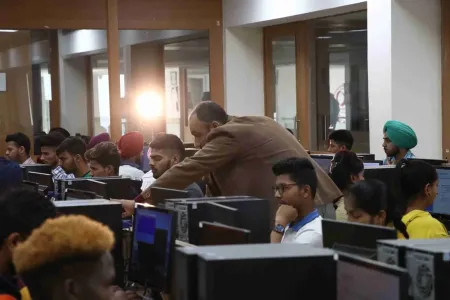
Industry immersion in MCA provides students with real-world exposure through internships, live projects, and industry collaborations.
It helps bridge the gap between academic learning and professional practices in IT and software industries. Students work on real-time challenges, understand industry workflows, and develop job-ready technical skills. Guest lectures, workshops, and company visits further enhance their understanding of emerging technologies. This experience boosts employability by building confidence, professional networks, and practical expertise.

Major Courses Offered

  1. Python + Clean Coding
  2. Data Visualization
  3. Artificial Intelligence
  4. Machine Learning
  5. Deep Learning
  6. Predictive Analysis
  7. NoSQL
  8. Devops
  9. Data Sciences
  10. Big Data Fundamentals
  11. BlockChain Technology

eligibility criteria

Passed any graduation degree (e.g.: B.E. / B.Tech./ B.Sc / B.Com. / B.A./ B. Voc./ BCA etc.,) preferably with Mathematics at 10+2 level
OR
at Graduation level obtained at least 50% marks (45% marks in case of candidates belonging to reserved category) in the qualifying examination. (for students having no Mathematics background compulsory bridge course will be framed by the University for non technical students.

Admission criteria

Merit in CT-SET, subject to fulfilling eligibility criteria.

Duration

2 Years

Curriculum

1ST SEMESTER SUBJECTS

Covers the software development life cycle, requirements engineering, design and testing methodologies, software quality assurance, and project planning, estimation, scheduling, and risk management techniques used to manage software projects effectively.
Course Outcome:
CO1: Understand the fundamental concepts of software engineering, including software process models and their applicability to different types of projects.
CO2: Analyze and document software requirements effectively, and prepare a Software Requirements Specification (SRS) using appropriate analysis tools.
CO3: Apply software design principles and UML modeling techniques to develop architectural and detailed designs for software systems.
CO4: Apply various software testing techniques and strategies to ensure software quality and reliability.
CO5: Apply project management techniques such as estimation, scheduling, and risk management to plan and manage software projects effectively.
CO6: Understand software configuration management practices and apply appropriate maintenance strategies throughout the software lifecycle.

Explores advanced networking concepts including network architectures, routing and switching protocols, network security, wireless and mobile networks, and emerging technologies such as SDN and cloud-based networking.
Course Outcome:
CO1: Understand the foundational principles of network security, including the CIA triad, types of attacks, and cryptographic mechanisms used to secure network communications.
CO2: Analyze and apply cryptographic algorithms and authentication protocols such as AES, RSA, Diffie-Hellman, and Kerberos to design secure communication systems.
CO3: Evaluate and implement network security protocols including IPSec, SSL/TLS, VPN, and SSH to ensure secure data transmission across networks.
CO4: Design and configure firewall architectures, IDS/IPS systems, and access control mechanisms to protect network infrastructure from unauthorized access.
CO5: Identify, analyze, and mitigate advanced cyber threats such as DDoS, APT, malware, and web-based attacks using appropriate countermeasures and security frameworks.
CO6: Explore and apply emerging network security concepts including wireless security, cloud security, IoT security, and network forensics to address modern cybersecurity challenges.

Focuses on advanced relational database concepts including normalization, transaction management, concurrency control, query optimization, distributed databases, and administration of enterprise-grade database systems.
Course Outcome:
CO1: Review and apply core relational database concepts including relational algebra, normalization, and SQL to design and implement well-structured relational schemas.
CO2: Write and optimize advanced SQL queries using stored procedures, triggers, window functions, and indexing strategies to improve database performance and efficiency.
CO3: Analyze and implement transaction management and concurrency control mechanisms to ensure data consistency, integrity, and isolation in multi-user database environments.
CO4: Apply database recovery techniques and security mechanisms to protect database systems from failures, unauthorized access, and data breaches.
CO5: Understand and implement distributed database concepts including fragmentation, replication, and distributed transaction management to build scalable and fault-tolerant systems.
CO6: Explore advanced RDBMS topics such as object-relational models, temporal and spatial databases, data warehousing, and integration with modern Big Data technologies to address complex data management challenges.

Provides hands-on practice in designing, implementing, and querying relational databases, writing complex SQL queries, stored procedures, triggers, and performing database tuning and administration tasks.
Course Outcome:
CO1: Design and develop conceptual and relational database models using ER diagrams, normalization techniques, and integrity constraints.
CO2: Create, modify, and manage database objects using SQL DDL, DML, and DCL commands.
CO3: Apply SQL queries, built-in functions, nested queries, joins, and constraints to retrieve and manipulate data efficiently.
CO4: Develop advanced database programs using cursors, stored procedures, functions, triggers, and embedded SQL.
CO5: Implement database administration tasks including user management, role creation, privilege assignment, and data import/export operations.
CO6: Design and implement complete database applications by integrating database design, programming, querying, and administration techniques.

Covers advanced data structures such as trees, graphs, and hashing along with algorithm design paradigms including divide-and-conquer, dynamic programming, and greedy methods, implemented and analyzed using Python.
Course Outcome:
CO1: Analyze and evaluate the time and space complexity of algorithms using asymptotic notations and apply Python's OOP features to implement efficient Abstract Data Types.
CO2: Design and implement advanced linear data structures such as skip lists, monotonic stacks, priority queues, and string structures to solve complex computational problems efficiently.
CO3: Implement and apply advanced tree data structures including AVL trees, segment trees, tries, and heaps to solve problems related to searching, sorting, and hierarchical data management.
CO4: Apply graph algorithms including shortest path, minimum spanning tree, topological sort, network flow, and strongly connected components to model and solve real-world network problems using Python.
CO5: Design solutions to complex computational problems using algorithm design paradigms such as dynamic programming, greedy algorithms, backtracking, and branch and bound techniques.
CO6: Explore and apply advanced algorithmic concepts including hashing, string matching, computational geometry, NP-completeness, and Python optimization libraries to solve modern and large-scale computational challenges.

Offers practical implementation of advanced data structures and algorithms in Python, reinforcing algorithmic problem-solving skills and performance analysis through coding exercises.
Course Outcome:
CO1: Apply Python programming concepts to implement fundamental and advanced data structures.
CO2: Develop and analyze algorithms for searching, sorting, and data organization problems.
CO3: Implement linear and non-linear data structures such as linked lists, trees, heaps, and graphs.
CO4: Design solutions using algorithmic paradigms including recursion, divide-and-conquer, greedy, dynamic programming, and backtracking.
CO5: Analyze algorithm efficiency using asymptotic notations and compare performance of different approaches.
CO6: Develop optimized Python-based solutions for real-world computational problems using advanced data structures and algorithms.

Introduces contemporary artificial intelligence techniques and data analysis methods, including machine learning fundamentals, data preprocessing, exploratory data analysis, and their applications in solving real-world problems.
Course Outcome:
CO1: Understand the foundational concepts of Artificial Intelligence and Data Analysis, and apply Python libraries to collect, explore, and visualize real-world datasets effectively.
CO2: Apply data preprocessing and exploratory data analysis techniques including feature engineering, dimensionality reduction, and statistical analysis to prepare high-quality datasets for modeling.
CO3: Implement and evaluate supervised and unsupervised machine learning algorithms using Scikit-learn to solve classification, regression, and clustering problems on real-world data.
CO4: Design and train deep learning models including CNN, RNN, LSTM, and GANs using TensorFlow and PyTorch for tasks such as image recognition, sequence prediction, and data generation.
CO5: Apply Natural Language Processing and Computer Vision techniques using transformer-based models, LLMs, and OpenCV to build intelligent text and image understanding applications.
CO6: Explore modern AI trends including Big Data integration, MLOps, Explainable AI, Reinforcement Learning, Edge AI, and ethical considerations to design responsible and scalable AI systems.

Introduces complete web application development covering front-end, back-end, databases, APIs, and server-side technologies. Students learn to design, develop, integrate, and deploy responsive and dynamic full-stack applications.
Course Outcome:
CO1: Design and develop responsive, accessible, and visually appealing web interfaces using HTML5, CSS3, JavaScript, and modern CSS frameworks like Bootstrap and Tailwind CSS.
CO2: Build dynamic and interactive single-page applications using React.js, Next.js, TypeScript, and state management tools while applying best practices in component design and testing.
CO3: Develop scalable and secure RESTful and GraphQL APIs using Node.js and Express.js with proper authentication, authorization, and real-time communication capabilities.
CO4: Design and integrate relational and non-relational databases using PostgreSQL, MongoDB, and Redis with appropriate ORM/ODM tools to manage and optimize application data effectively.
CO5: Deploy and manage full stack applications using Docker, Kubernetes, CI/CD pipelines, and cloud platforms such as AWS and Google Cloud following modern DevOps practices.
CO6: Apply advanced full stack concepts including microservices, serverless architecture, PWA, web security, performance optimization, and AI integration to build modern, scalable, and production-ready web applications.

Provides hands-on practice in developing complete web applications using front-end and back-end technologies with database integration. Students implement APIs, authentication, CRUD operations, responsive interfaces, and application deployment.
Course Outcome:
CO1: Design and develop responsive user interfaces using modern front end technologies.
CO2: Implement client-side scripting and component-based web applications for interactive user experiences.
CO3: Develop and integrate RESTful APIs and server-side applications for handling business logic.
CO4: Design and manage databases and perform CRUD operations in full stack applications.
CO5: Implement authentication, authorization, testing, deployment, and version control practices in web development.
CO6: Build and deploy complete full stack web applications by integrating frontend, backend, and database technologies.

An elective examining principles of network security and cryptographic techniques, including symmetric and asymmetric encryption, hashing, digital signatures, authentication protocols, and security threats and defenses.
Course Outcome:
CO1: Explain the concepts, threats, and principles of network security.
CO2: Apply cryptographic techniques for securing information and communication.
CO3: Analyze encryption, authentication, and key management mechanisms.
CO4: Utilize network security protocols for secure communication.
CO5: Apply network defense mechanisms to protect systems and networks.
CO6: Evaluate emerging security challenges and cyber security solutions.

Practical elective lab for implementing cryptographic algorithms and network security mechanisms, including encryption/decryption techniques, hashing, and basic security protocol simulations.
Course Outcome:
CO1: Use network security tools for monitoring and analysis.
CO2: Implement classical and modern cryptographic techniques.
CO3: Apply encryption, decryption and authentication mechanisms.
CO4: Analyze network traffic and identify security threats.
CO5: Configure security controls for network protection.
CO6: Perform basic security assessment and vulnerability analysis.

An elective introducing the R programming language for statistical computing and data analysis, covering data structures, data manipulation, visualization, and statistical modeling in R.
Course Outcome:
CO1: Explain the fundamentals of R programming, including data types, operators, variables, and control structures.
CO2: Apply R functions, vectors, matrices, lists, and data frames to solve computational problems.
CO3: Analyze and manipulate datasets using R programming techniques.
CO4: Create suitable visualizations in R for effective interpretation of data.
CO5: Develop R programs for basic statistical analysis and data-driven problem solving.

Hands-on elective lab for applying R programming to real datasets, covering data import/cleaning, visualization, and basic statistical analysis using R.
Course Outcome:
CO1: Develop basic R programs using variables, data types, operators, expressions, and control structures.
CO2: Apply R programming concepts such as vectors, matrices, arrays, lists, and data frames to solve computational problems.
CO3: Implement functions and perform data manipulation using R for handling and processing datasets.
CO4: Analyze datasets using basic statistical techniques available in R.
CO5: Create suitable charts and graphs in R to visualize and interpret data effectively.
CO6: Develop simple R-based solutions for real-world data analysis problems using appropriate programming and analytical techniques.

2ND SEMESTER SUBJECTS

Covers core machine learning concepts including supervised and unsupervised learning, regression, classification, clustering, and model evaluation, implemented using Python and popular ML libraries.
Course Outcome:
CO1: Explain fundamental concepts and principles of machine learning and its applications.
CO2: Apply Python programming and machine learning libraries for data preprocessing and analysis.
CO3: Implement supervised learning techniques such as regression and classification for solving predictive problems.
CO4: Apply unsupervised learning techniques such as clustering to analyze datasets.
CO5: Evaluate and compare machine learning models using appropriate performance measures.
CO6: Develop suitable machine learning solutions for real-world problems using Python.

Hands-on lab for implementing machine learning algorithms in Python, covering data preprocessing, model building, training, and evaluation on real-world datasets.
Course Outcome:
CO1: Implement basic machine learning programs using Python and appropriate libraries.
CO2: Perform data cleaning, preprocessing, feature selection, and transformation on datasets.
CO3: Build and train supervised learning models for regression and classification problems.
CO4: Implement clustering algorithms and analyze patterns in datasets.
CO5: Evaluate machine learning models using suitable performance metrics and visualization techniques.
CO6: Develop and test machine learning solutions using real-world datasets.

Introduces data warehousing concepts including ETL processes, OLAP, dimensional modeling, and business intelligence tools used for data-driven decision making and reporting.
Course Outcome:
CO1: Explain the concepts, architecture, and components of data warehouses and business intelligence.
CO2: Apply ETL techniques for extracting, transforming, and loading data into a data warehouse.
CO3: Design dimensional models using facts, dimensions, star schemas, and snowflake schemas.
CO4: Apply OLAP operations for multidimensional data analysis.
CO5: Use business intelligence techniques and tools to generate meaningful reports and insights.
CO6: Analyze organizational data to support data-driven decision making.

Explores soft computing techniques including fuzzy logic, artificial neural networks, genetic algorithms, and hybrid systems used to solve complex, real-world problems involving uncertainty and imprecision.
Course Outcome:
CO1: Explain the fundamental concepts and principles of soft computing techniques.
CO2: Apply fuzzy logic concepts to solve problems involving uncertainty and imprecision.
CO3: Design and implement basic artificial neural network models for problem solving.
CO4: Apply genetic algorithms to optimization and search problems.
CO5: Compare different soft computing techniques based on their suitability for specific problems.
CO6: Develop suitable soft computing solutions for complex real-world problems.

Covers principles of research methodology including literature review, research design, data collection and analysis techniques, academic writing, and preparation of a formal project proposal.
Course Outcome:
CO1: Explain the fundamental concepts, types, and processes of research.
CO2: Conduct systematic literature reviews using appropriate academic and research resources.
CO3: Formulate research problems, objectives, research questions, and hypotheses.
CO4: Apply appropriate research methods for data collection, analysis, and interpretation.
CO5: Prepare academic and technical documents using appropriate research writing and citation practices.
CO6: Develop and present a structured research/project proposal based on an identified problem.

Covers formal languages, automata theory, regular expressions, context-free grammars, Turing machines, and computability and complexity theory, forming the theoretical foundation of computer science.
Course Outcome:
CO1: Explain the fundamental concepts of formal languages, grammars, and automata theory.
CO2: Construct and analyze finite automata for recognizing regular languages.
CO3: Apply regular expressions and context-free grammars to represent and analyze formal languages.
CO4: Construct and analyze pushdown automata for context-free languages.
CO5: Explain the structure and computational capabilities of Turing machines.
CO6: Analyze basic concepts of computability, decidability, and computational complexity.

Explores advanced operating system concepts including process management, synchronization, distributed systems, memory management, file systems, and resource allocation. Emphasizes modern OS architectures, virtualization, concurrency, and performance management.
Course Outcome:
CO1: Understand advanced operating system architectures, including microkernel, hybrid, and real-time systems.
CO2: Apply advanced process scheduling techniques for multiprocessor, multicore, and real-time systems.
CO3: Analyze advanced synchronization and concurrency control mechanisms in distributed environments.
CO4: Evaluate distributed operating system concepts, including distributed file systems and consensus algorithms.
CO5: Examine virtualization and cloud operating system technologies, including hypervisors and containerization.
CO6: Analyze operating system security mechanisms and case studies of modern operating systems.

Provides comprehensive knowledge of Linux operating system administration, configuration, security, networking, and system management. Develops practical skills in user management, file systems, processes, services, permissions, shell commands, and troubleshooting.
Course Outcome:
CO1: Explain Linux architecture, RHEL ecosystem, installation process, and Linux file system.
CO2: Apply Linux commands for file, directory, text, and process management using the command line.
CO3: Configure users, groups, permissions, software packages, and system services in RHEL.
CO4: Manage storage devices, partitions, logical volumes, and configure networking in Linux.
CO5: Configure remote access, web services, file sharing, firewall, and security in RHEL.
CO6: Perform system monitoring, backup, automation, troubleshooting, and shell scripting for Linux administration.

An elective introducing blockchain fundamentals including distributed ledgers, consensus mechanisms, cryptographic principles, smart contracts, and applications of blockchain across various industries.
Course Outcome:
CO1: Explain the fundamental concepts, architecture, and components of blockchain technology.
CO2: Describe the role of cryptography and distributed ledgers in blockchain systems.
CO3: Analyze different blockchain consensus mechanisms and their applications.
CO4: Explain the structure, functionality, and applications of smart contracts.
CO5: Evaluate blockchain applications across different industries and use cases.
CO6: Design suitable blockchain-based solutions for real-world applications.

Practical elective lab for building and deploying blockchain applications, including writing and testing smart contracts and working with blockchain development platforms.
Course Outcome:
CO1: Configure and work with basic blockchain development environments and platforms.
CO2: Implement fundamental blockchain concepts using suitable development tools.
CO3: Develop, test, and deploy basic smart contracts.
CO4: Apply cryptographic and consensus concepts in blockchain-based applications.
CO5: Develop simple decentralized applications using blockchain technologies.
CO6: Test and evaluate blockchain applications for appropriate real-world use cases.

An elective covering fundamentals of computer graphics including rendering, transformations, modeling, and data visualization techniques used to represent and interpret complex data visually.
Course Outcome:
CO1: Explain the fundamental concepts and principles of computer graphics and visualization.
CO2: Apply geometric transformations such as translation, rotation, scaling, and reflection.
CO3: Explain and apply basic rendering, modeling, and viewing techniques.
CO4: Apply computer graphics algorithms for generating and manipulating graphical objects.
CO5: Apply visualization techniques to represent and interpret complex data effectively.
CO6: Analyze and select appropriate graphics and visualization techniques for real-world applications.

Hands-on elective lab for implementing computer graphics and visualization techniques, including rendering, transformations, and building visual representations of data.
Course Outcome:
CO1: Implement basic computer graphics programs using appropriate programming tools.
CO2: Implement two-dimensional and three-dimensional geometric transformations.
CO3: Develop graphical objects using suitable rendering and modeling techniques.
CO4: Implement basic graphics algorithms for drawing and manipulating graphical objects.
CO5: Create visual representations of data using appropriate visualization techniques.
CO6: Develop and demonstrate simple computer graphics and visualization applications.

3RD SEMESTER SUBJECTS

This course covers the fundamentals of digital image processing including image acquisition, sampling, quantization, image enhancement, restoration, segmentation, morphological processing, image compression, and object recognition techniques used in intelligent vision and security systems.
Course Outcome:
CO1: Understand fundamentals of digital image formation, sampling, and quantization.
CO2: Apply spatial and frequency domain techniques for image enhancement and filtering.
CO3: Implement image restoration techniques to remove noise and degradation.
CO4: Apply segmentation and morphological operations to extract meaningful image regions.
CO5: Understand image compression techniques for efficient storage and transmission.
CO6: Apply feature extraction and pattern recognition techniques for object detection and image classification.

Provides hands-on practice in implementing image processing algorithms including image enhancement, filtering, segmentation, morphological operations, and object detection using Python-based image processing libraries.
Course Outcome:
CO1: Implement image acquisition, reading, and basic manipulation operations using Python libraries.
CO2: Apply spatial domain enhancement techniques such as histogram equalization and spatial filtering.
CO3: Implement frequency domain filtering using Fourier transform techniques.
CO4: Apply noise removal and image restoration techniques on degraded images.
CO5: Implement image segmentation and edge detection algorithms.
CO6: Develop a complete image processing application integrating enhancement, segmentation, and feature extraction.

Covers advanced Java programming concepts including multithreading, the Collections Framework, exception handling, JDBC connectivity, and servlet-based web application development for building robust, scalable software solutions.
Course Outcome:
CO1: Understand advanced object-oriented programming concepts and the Java Collections Framework.
CO2: Apply multithreading and exception handling techniques to build robust applications.
CO3: Implement database connectivity using JDBC for data-driven applications.
CO4: Develop web-based applications using Servlets and related Java EE technologies.
CO5: Apply design patterns to build maintainable and scalable Java applications.
CO6: Design and develop an enterprise-level application using advanced Java features.

Provides hands-on practice in implementing advanced Java concepts including multithreading, collections, JDBC connectivity, and servlet-based web applications.
Course Outcome:
CO1: Implement multithreaded Java programs to handle concurrent tasks.
CO2: Apply the Collections Framework to manage and manipulate data structures.
CO3: Develop database-driven applications using JDBC.
CO4: Build dynamic web applications using Servlets.
CO5: Apply exception handling techniques to build fault-tolerant programs.
CO6: Develop a complete Java-based application integrating database and web components.

Covers software testing fundamentals including test case design, black-box and white-box testing techniques, test automation, software quality models, and quality assurance practices used to ensure reliable software delivery.
Course Outcome:
CO1: Understand software testing fundamentals and the software testing life cycle.
CO2: Design test cases using black-box and white-box testing techniques.
CO3: Apply unit, integration, and system testing methods to validate software.
CO4: Use test automation tools to streamline the testing process.
CO5: Apply software quality models and metrics to assess software quality.
CO6: Develop a test plan and quality assurance strategy for a software project.

Hands-on lab for applying software testing techniques including test case design, automated testing tools, and defect tracking to evaluate software quality.
Course Outcome:
CO1: Design and execute test cases for a given software application.
CO2: Apply automated testing tools to perform functional and regression testing.
CO3: Identify, log, and track defects using a defect tracking tool.
CO4: Perform unit testing using appropriate testing frameworks.
CO5: Apply performance and load testing techniques to evaluate software behavior.
CO6: Prepare a test summary report documenting testing outcomes.

Covers the principles and methodology of digital forensics including evidence acquisition, preservation, chain of custody, file system and memory forensics, network forensics, and forensic reporting for investigating cyber incidents.
Course Outcome:
CO1: Understand digital forensics principles, legal considerations, and the forensic investigation process.
CO2: Apply evidence acquisition and preservation techniques while maintaining chain of custody.
CO3: Perform file system and disk forensic analysis to recover and examine digital evidence.
CO4: Conduct memory forensics to analyze volatile data from compromised systems.
CO5: Perform network forensic analysis to investigate network-based security incidents.
CO6: Prepare a comprehensive forensic investigation report suitable for legal proceedings.

Covers discrete mathematical structures including set theory, relations, graph theory, combinatorics, and optimization techniques used for problem-solving in computer science.
Course Outcome:
CO1: Apply set theory, relations, and functions to model computational problems.
CO2: Analyze graphs and trees to solve computer science problems.
CO3: Apply combinatorial techniques for counting and probability problems.
CO4: Understand principles of linear and nonlinear optimization.
CO5: Apply optimization techniques to solve real-world computational problems.
CO6: Formulate and solve discrete optimization problems using appropriate algorithms.

Introduces full-stack web development using the MERN stack (MongoDB, Express.js, React.js, and Node.js), covering front-end and back-end development, RESTful API design, and database integration.
Course Outcome:
CO1: Understand the architecture and components of the MERN stack.
CO2: Develop responsive user interfaces using React.js.
CO3: Build RESTful APIs using Node.js and Express.js.
CO4: Design and integrate NoSQL databases using MongoDB.
CO5: Implement authentication and state management in full-stack applications.
CO6: Develop and deploy a complete full-stack web application using the MERN stack.

Hands-on lab for building full-stack web applications using MongoDB, Express.js, React.js, and Node.js.
Course Outcome:
CO1: Set up a MERN stack development environment.
CO2: Develop front-end components and pages using React.js.
CO3: Build and test RESTful APIs using Express.js and Node.js.
CO4: Perform CRUD operations using MongoDB.
CO5: Integrate front-end and back-end components into a working application.
CO6: Deploy a complete MERN stack application.

Evaluates the summer internship undertaken by students after Semester II, assessing the practical exposure gained in an industry or research environment through a report and presentation before the school committee.
Course Outcome:
CO1: Demonstrate the practical skills and industry exposure gained during the summer internship.
CO2: Prepare a comprehensive internship report documenting the work undertaken.
CO3: Present and defend the internship work before the evaluation committee.

Involves the design and development of a minor project applying cyber security and computing concepts learned throughout the programme, culminating in a working prototype and project report.
Course Outcome:
CO1: Identify a real-world problem suitable for a cyber security or computing-based solution.
CO2: Design and develop a working prototype applying appropriate techniques and tools.
CO3: Document and present the project work through a report and demonstration.

Introduces IoT architecture, sensors, actuators, communication protocols, and robotics fundamentals, covering the integration of IoT devices with security principles for building smart, secure, and autonomous systems.
Course Outcome:
CO1: Understand IoT architecture, protocols, and sensor-actuator systems.
CO2: Apply communication protocols for IoT device connectivity.
CO3: Understand fundamentals of robotics including kinematics and control systems.
CO4: Apply security techniques for protecting IoT and robotic systems.
CO5: Design an IoT-based system for real-world monitoring or automation applications.
CO6: Analyze security and privacy challenges in IoT and robotic systems.

Hands-on lab for building IoT and robotics applications using microcontrollers, sensors, actuators, and secure communication protocols.
Course Outcome:
CO1: Set up and program microcontroller-based IoT development boards.
CO2: Interface sensors and actuators with IoT devices.
CO3: Implement secure communication protocols for IoT data transmission.
CO4: Build a basic robotic system with sensor-based control.
CO5: Identify and mitigate security vulnerabilities in an IoT/robotics application.
CO6: Develop a complete IoT/robotics prototype for a real-world use case.

Covers the fundamentals of data science including data collection, data wrangling, exploratory data analysis, statistical modeling, and data visualization techniques for extracting insights from data, including security-relevant datasets.
Course Outcome:
CO1: Understand the data science process and lifecycle.
CO2: Apply data collection and data wrangling techniques to prepare data for analysis.
CO3: Perform exploratory data analysis to identify patterns and trends in data.
CO4: Apply statistical modeling techniques for data analysis.
CO5: Apply data visualization techniques to communicate insights effectively.
CO6: Apply data science techniques to solve real-world analytical and security problems.

Hands-on lab applying data science techniques using Python, covering data wrangling, exploratory data analysis, statistical modeling, and visualization.
Course Outcome:
CO1: Perform data cleaning and preprocessing using Python libraries.
CO2: Conduct exploratory data analysis using statistical and visualization techniques.
CO3: Apply statistical modeling techniques to analyze datasets.
CO4: Build data visualization dashboards to communicate insights.
CO5: Apply hypothesis testing techniques to validate analytical findings.
CO6: Develop a complete data analysis project applying the full data science pipeline.

4TH SEMESTER SUBJECTS

Involves the design, development, and implementation of a comprehensive major project addressing a real-world cyber security problem, applying the complete knowledge and skills gained throughout the programme, culminating in a dissertation report and final viva-voce presentation.
Course Outcome:
CO1: Identify and formulate a significant real-world problem suitable for a cyber security-based solution.
CO2: Design a comprehensive system architecture and methodology to address the identified problem.
CO3: Develop, implement, and test a complete working solution applying appropriate cyber security techniques and tools.
CO4: Evaluate the developed solution using appropriate performance and security metrics.
CO5: Document the project work in a comprehensive project report following academic and technical writing standards.
CO6: Present and defend the project work before an evaluation committee, demonstrating professional communication skills.

Provides students with extended industry exposure through a structured industrial training program, enabling them to apply their academic knowledge to real-world organizational cyber security problems, develop professional skills, and gain practical experience in an industry environment.
Course Outcome:
CO1: Apply academic knowledge and skills to solve real-world cyber security problems in an industrial setting.
CO2: Demonstrate professional and workplace skills including teamwork, communication, and time management.
CO3: Document the industrial training experience through a comprehensive training report.
CO4: Present and defend the industrial training work before the evaluation committee.

fees

Details

Amount

Programme Fees (per Semester)

60000

Examination Fees

3000

International Fees (per Year)

$3200

Fee Slab

Slab >=60% - 74.99% >=75% - 89.99% >=90% & Above
Fee ₹55000 ₹50000 ₹45000

Students can avail these slots depending on the marks they have scored. Each slot reflects a different academic range, helping students understand where they stand and what benefits they qualify for.


Programme Outcomes

  • Acquire comprehensive knowledge of key concepts and technologies in Full Stack Development, AI & Data Science, and Cyber Security & Forensics.
  • Improve the ability to assess complex problems and create effective solutions utilizing suitable technologies and methodologies.
  • Develop project management skills and the capacity to collaborate efficiently within multidisciplinary teams.
  • Nurture a research-driven mindset to investigate innovative solutions and contribute to technological advancements.
  • Embed a sense of ethical and professional responsibility in the practice of computing and technology.
  • Promote a dedication to lifelong learning and adaptability to stay current with evolving technologies and industry requirements.

Programme Specific Outcomes

  • Gain comprehensive knowledge and expertise in specialized areas such as Full Stack Development, AI & Data Science, Cyber Security & Forensics, and other emerging technologies. Develop the capability to apply these skills in practical settings to create innovative solutions.
  • Cultivate the ability to combine knowledge from various specializations to analyze and solve complex problems. Enhance analytical and critical thinking skills to address challenges across multiple domains of computing and technology.
  • Foster a strong commitment to ethical practices and professional responsibilities in computing. Encourage lifelong learning, adaptability, and effective teamwork to meet the evolving needs of the technology industry.

Salient Features

  • Focus on advanced programming, application development, and system design.
  • Industry-oriented curriculum with updated technologies like AI, ML, cloud, and cybersecurity.
  • Strong emphasis on practical learning through labs, projects, and internships
  • Opportunities for industry immersion, live projects, and corporate collaborations.
  • Development of both technical skills (coding, software development) and soft skills (communication, teamwork).
  • Placement assistance and training programs for better career opportunities
  • Flexibility to specialize in emerging areas like Data Science, IoT, Blockchain, etc.
  • Experienced faculty with academic and industry backgrounds.
  • Focus on innovation, entrepreneurship, and problem-solving mindset.

Infrastructure