Apply Now Programmes Virtual Tour CT-SET 2026 Ph.D
Admissions
Open 2026-27
Apply now
Apply Now

B.Tech Computer Science and Engineering with Specialisation in Cloud Computing

program-details

The B.Tech. in Computer Science and Engineering (Cloud Computing) is designed to equip students with the knowledge and skills required to develop, deploy, and manage applications on cloud platforms. The Programme focuses on cloud infrastructure, virtualization, distributed computing, containerization, cloud security, DevOps, and scalable application development. Students gain hands-on experience through modern tools such as AWS, Azure, Google Cloud Platform, Docker, Kubernetes, and cloud automation frameworks.

Industry Immersion

The Programme integrates strong industry exposure through:

  • Internships / Industry Training with leading IT companies and cloud service providers.
  • Live Projects and Capstone Projects in collaboration with industry partners.
  • Workshops and Masterclasses conducted by professionals from AWS, Microsoft Azure, and Google Cloud.
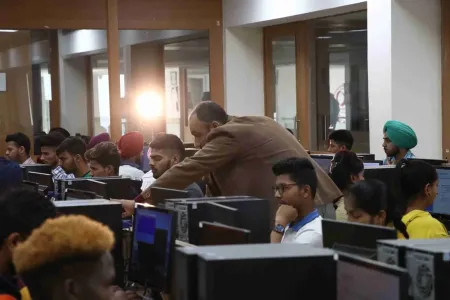
  • Hands-on Training using real cloud platforms and virtualization environments.
  • Industry Certifications Support, such as:
    1. AWS Cloud Practitioner
    2. Azure Fundamentals
    3. Google Cloud Associate Engineer
    4. VMware Certifications
    5. RedHat Certifications

eligibility criteria

Passed 10+2 examination with Physics/ Mathematics/ Chemistry/ Computer Science/ Electronics/ Information Technology/ Biology/ Informatics Practices/ Biotechnology/ Technical Vocational subject/ Agriculture/ Engineering Graphics/ Business Studies/ Entrepreneurship as per table 8.4 Agriculture stream (for Agriculture Engineering) Obtained at least 45% marks (40% marks in case of candidates belonging to reserved category) in the above subjects taken together 
OR
Passed D.Voc. Stream in the same or allied sector (The Universities will offer suitable bridge courses such as Mathematics, Physics, Engineering drawing, etc., for the students coming from diverse backgrounds to prepare Level playing field and desired learning outcomes of the programme)

Admission criteria

Merit in Scholarship Test, subject to fulfilling eligibility criteria.

Duration

4 Years

Curriculum

1ST SEMESTER SUBJECTS

Applied Physics provides fundamental knowledge of mechanics, waves, optics, electricity, magnetism, and modern physics, emphasizing practical applications and problem-solving skills essential for engineering and technological development.
Course Outcome:
At the end of the course, the student will be able to-
CO1: Acquire knowledge about the Maxwell equation and Electromagnetic spectrum
CO2: Understand laser system in industries, laboratories and in communication
CO3: Acquire knowledge about the Crystallography, superconductivity and Magnetic materials.
CO4: Appreciate the need for quantum mechanics, wave particle duality, uncertainty principle etc. and their applications.
CO5: Understand the properties and synthesis of nanomaterials.

Applied Physics Laboratory develops practical skills through experiments in mechanics, optics, electricity, magnetism, and semiconductor physics, enabling students to verify theoretical concepts, analyze experimental data, and understand physical phenomena.
Course Outcome:
At the end of the course, students will be:
CO1: Able to verify some of the theoretical concepts learnt in the theory courses.
CO2: Trained in carrying out precise measurements and handling sensitive equipment.
CO3: Introduced to the methods used for estimating and dealing with experimental uncertainties and systematic errors.
CO4: Learn to draw conclusions from data and develop skills in experimental design.
CO5: Write a technical report which communicates scientific information in a clear and concise manner.

Programming Concepts introduces the fundamentals of computer programming, including problem-solving techniques, algorithms, flowcharts, data types, operators, control structures, functions, and arrays, using a structured programming language.
Course Outcome:
At the end of the course, the students will able to be:
CO1: Describe the procedural and object-oriented paradigm with concepts of streams, classes, functions, data and objects.
CO2: Understand dynamic memory management techniques using pointers, constructors, destructors, etc.
CO3: Describe the concept of function overloading, operator overloading, virtual functions and polymorphism.
CO4: Understanding inheritance in OOP for code reusability and extensible design.
CO5: Demonstrate the use of various OOPs concepts with the help of programs.

Programming Concepts Lab provides hands-on practice in writing, debugging, and executing programs based on the concepts covered in programming Concepts, including control structures, functions, and arrays.
Course Outcome:
At the end of the course, the students will able to be:
CO1: Describe the procedural and object-oriented paradigm with concepts of streams, classes, functions, data and objects.
CO2: Understand dynamic memory management techniques using pointers, constructors, destructors, etc.
CO3: Describe the concept of function overloading, operator overloading, virtual functions and polymorphism.
CO4: Understanding inheritance in OOPs for code reusability and extensible design.
CO5: Demonstrate the use of various OOPs concepts with the help of programs.

This course provides evelops advanced concepts in multivariable calculus, vector calculus, differential equations, Laplace transforms, and numerical methods, equipping students with mathematical techniques for solving engineering problems.
Course Outcome:
At the end of the course, the students will be able to:
CO1: Able to verify some of the theoretical concepts learnt in the theory courses.
CO2: trained to visualize and conceptualize the engineering problems
CO3: Relate matrices and linear transformations, compute Eigen values and Eigen vectors of linear transformations.
CO4: Solve engineering problems by making use of ordinary differential equations.
CO5: Inter-relationship amongst the line integral, double and triple integral formulations.

Workshop Practices provides hands-on exposure to basic manufacturing trades such as carpentry, fitting, welding, sheet metal work, and plumbing, along with workshop safety practices.
Course Outcome:
At the end of the course, the students will be able to:
CO1: Prepare moulds, cores and wooden joints for basic manufacturing applications.
CO2: Perform basic welding operations and fabricate simple welded joints.
CO3: Carry out fitting and machining operations using conventional workshop tools and machines.
CO4: Fabricate simple products using sheet metal and forging processes.
CO5: Demonstrate basic electrical wiring, soldering and electronic circuit assembly practices.

Environmental Studies develops awareness of ecosystems, biodiversity, natural resources, pollution, climate change, environmental management, and sustainable development, encouraging responsible practices and informed solutions to environmental challenges.
Course Outcome:
At the end of the course, the students will be able to:
CO1: Analyse the impact of Biodiversity conservation on species and the environment.
CO2: Apply knowledge of environmental policies and legislations to evaluate and propose solutions for local and global environmental issues.
CO3: Implement environmental management plans to address campus environmental issues such as Waste disposal, water management, and sanitation.
CO4: Students will gain knowledge of the structure and function of ecosystems, biodiversity, and the importance of natural resources.
CO5: Recognize the interdependence between humans and the environment.

Communicative English-I develops foundational language skills in grammar, vocabulary, listening, speaking, reading, and writing for effective communication.
Course Outcome:
At the end of the course, the students will be able to:
CO1: Use standard English aptly in listening, speaking, and communicative situations
CO2: Write error-free sentences and short texts in English Language
CO3: Comprehend reading passages effectively
CO4: Demonstrate use of apt and relevant vocabulary at lower intermediate to intermediate level
CO5: Develop effective oral presentation skills, including audience analysis and body language
CO6: Apply audio-visual aids to enhance communication and improve pronunciation

This course develops an entrepreneurial mindset through self-awareness, creativity, innovation, opportunity recognition, problem-solving, communication, teamwork, leadership, and professional ethics. Students are introduced to the startup ecosystem, design thinking, business models, prototyping, value propositions, and idea pitching to encourage solution-oriented thinking and entrepreneurial initiative.
Course Outcome:
CO1: Demonstrate self-awareness, confidence and growth mindset.
CO2: Apply creativity and innovation tools to generate ideas and solutions.
CO3: Identify opportunities through analysis of real-life and community problems.
CO4: Demonstrate effective communication, teamwork and leadership skills.
CO5: Explain entrepreneurship concepts, startup ecosystem and support systems.
CO6: Develop and present a solution-oriented entrepreneurial project.

Open Source Technology introduces the philosophy, licensing models, and ecosystem of open source software, covering collaborative development practices, version control, and contribution to open source projects.
Course Outcome:
At the end of the course, the students will be able to:
CO1: Understand the philosophy, history, and licensing models of open source software.
CO2: Use version control systems such as Git for collaborative software development.
CO3: Explore and evaluate popular open source tools, platforms, and communities.
CO4: Understand the process of contributing to open source projects.
CO5: Apply open source development practices in a small collaborative project.

Open Source Technology Lab provides hands-on practice with Git-based version control, open source tools, and collaborative workflows used in open source software development.
Course Outcome:
At the end of the course, the students will be able to:
CO1: Set up and use Git and GitHub for version control.
CO2: Fork, clone, and contribute changes to an open source repository.
CO3: Install, configure, and use common open source software tools.
CO4: Collaborate on a small open source project using issue tracking and pull requests.
CO5: Document a project following open source contribution guidelines.

2ND SEMESTER SUBJECTS

Applied Chemistry introduces fundamental chemical principles and their engineering applications, covering water chemistry, corrosion, materials, polymers, fuels, nanomaterials, spectroscopy, and green chemistry for sustainable technological development.
Course Outcome:
At the end of the course, the students will be able to achieve following outcomes:
CO1: Apply concepts of solution chemistry and water treatment for engineering applications and solve numerical problems related to concentration and hardness of water.
CO2: Describe the principles and applications of spectroscopic techniques (UV-Visible, IR, and NMR) for molecular characterization.
CO3: Explain the principles, classifications, and applications of chemical sensors used in environmental, biomedical, and industrial fields.
CO4: Classify polymers and explain their properties, synthesis, and applications in engineering and industrial sectors.
CO5: Analyze stereo chemical properties of organic molecules, determine molecular configurations, and interpret conformational stability.
CO6: Explain the mechanisms of organic reactions including substitution, addition, and elimination reactions, and apply them in basic organic synthesis.

Applied Chemistry Laboratory develops practical skills through experiments involving water analysis, corrosion, chemical reactions, material characterization, solution preparation, and analytical techniques, emphasizing safety, accuracy, and scientific interpretation.
Course Outcome:
At the end of the course, the students will be able to:
CO1: Demonstrate proficiency in laboratory safety practices, handling of chemical reagents, preparation of standard solutions, and the use of volumetric analysis apparatus.
CO2: Perform acid–base and redox titrations to determine the concentration or strength of unknown solutions and analyze experimental results accurately.
CO3: Determine physicochemical properties of samples, including pH, total hardness, total alkalinity, surface tension, viscosity, redox potential, and partition coefficient using appropriate analytical techniques.
CO4: Carry out organic chemistry experiments, including the preparation of iodoform, differentiation between aldehydes and ketones using qualitative tests, and separation of compounds by thin-layer chromatography.
CO5: Synthesize polymers or drugs and evaluate the properties of oils through saponification and acid value determination using standard laboratory methods.
CO6: Record experimental observations, perform calculations, interpret analytical data, and prepare laboratory reports while adhering to good laboratory practices and safety guidelines.

This course introduces fundamental concepts of electrical and electronic engineering, including circuits, electrical machines, semiconductor devices, digital systems, measurements, and practical applications in engineering and technology.
Course Outcome:
At the end of the course the students will be able to:
CO1: To Understand the fundamental concepts of electricity, such as voltage, current, resistance, power, and energy.
CO2: To understand AC and DC fundamentals and measure power factor in given circuit.
CO3: Describe the characteristics and applications of diodes and transistors.
CO4: To understand Electrical safety and explain the construction, working principle, performance and applications of transformers.
CO5: Understand number systems, logic gates, and basic combinational circuits.
CO6: Apply Boolean algebra and Karnaugh maps to simplify and design digital logic circuits.

This laboratory develops practical skills in electrical circuits, measurements, electronic components, semiconductor devices, digital circuits, and basic electrical systems through experiments, testing, analysis, and troubleshooting techniques.
Course Outcome:
At the end of the course, the students will be able to:
CO1: Understand the fundamental concepts of electricity, such as voltage, current, resistance, power, and energy
CO2: Develop the ability to analyze electrical circuits using techniques such as Ohm's law, Kirchhoff's laws, and network theorems.
CO3: Plot the I-V characteristics of various semiconductor devices.
CO4: Design electrical and electronic circuits by utilizing various components.
CO5: Verify the truth tables of various logic gates

This course provides advanced concepts in multivariable calculus, vector calculus, differential equations, Laplace transforms, and numerical methods, equipping students with mathematical techniques for solving engineering problems.
Course Outcome:
At the end of the course, the students will be able to:
CO1: Apply derivative tests in optimization problems appearing in social sciences, physical sciences, life sciences and a host of other disciplines.
CO2: Understand conceptual variations while advancing from one variable to several variables in calculus.
CO3: Find numerical solutions of system of linear equations and check the accuracy of the solutions.
CO4: Solve initial and boundary value problems in differential equations using numerical methods.
CO5: To find and analyze solution of Laplace equation using different numerical methods.

Engineering Drawing covers principles of orthographic projection, sectional views, isometric and pictorial drawings, and an introduction to computer-aided drafting (CAD).
Course Outcome:
At the end of the course, the students will be able to:
CO1: Identify and use engineering drawing instruments, symbols, and conventions.
CO2: Understand and apply projection methods for points, lines, planes, and solids.
CO3: Create accurate 2D drawings using scales and dimensioning techniques.
CO4: Generate isometric (3D) drawings from 2D orthographic views.
CO5: Use basic CAD tools to create and modify engineering drawings digitally.

C++ Programming introduces object-oriented programming concepts using C++, covering classes, objects, inheritance, polymorphism, templates, and standard template library (STL) usage.
Course Outcome:
At the end of the course, the students will be able to:
CO1: Understand the fundamentals of C++ syntax and object-oriented programming concepts.
CO2: Implement classes, objects, constructors, and destructors in C++.
CO3: Apply inheritance and polymorphism to design extensible C++ programs.
CO4: Use templates and exception handling to write generic and robust code.
CO5: Apply the Standard Template Library (STL) for efficient data handling.
CO6: Develop modular C++ applications integrating multiple OOP concepts.

C++ Programming Lab provides hands-on practice in writing, compiling, and debugging C++ programs covering object-oriented concepts, templates, and STL-based data structures.
Course Outcome:
At the end of the course, the students will be able to:
CO1: Write and execute basic C++ programs using control structures and functions.
CO2: Implement classes and objects with constructors, destructors, and access specifiers.
CO3: Apply inheritance and polymorphism in sample C++ applications.
CO4: Use STL containers and algorithms to solve programming problems.
CO5: Debug and test C++ programs using standard development tools.

Universal Human Values, covering self-awareness, love, compassion, truth, non-violence, righteousness, sacrifice, and inner transformation. Students will develop ethical decision-making, empathy, emotional intelligence, self-reflection, and value-based thinking for personal and professional life.
Course Outcome:
CO1: Define and identify core universal human values and relate them to their own lives.
CO2: Demonstrate self-awareness and initiate personal transformation (Human Revolution)
CO3: Appreciate the importance of Sewa (selfless service), compassion, and empathy.
CO4: Apply principles of truth, non-violence, and moral responsibility in real-life dilemmas.
CO5: Evaluate ethical decisions involving sacrifice and righteousness through case studies.
CO6: Reflect on the relevance of renunciation and simplicity in modern life for inner peace.

Communicative English II builds on foundational language skills with emphasis on advanced communication, presentation skills, group discussions, and technical writing.
Course Outcome:
CO1: Able to apply advanced English language skills for effective academic and professional communication.
CO2: Able to communicate ideas, information and opinions confidently through effective speaking and listening skills.
CO3: Able to comprehend, analyze and interpret various forms of written and spoken English.
CO4: Able to prepare effective professional documents such as emails, reports, presentations and resumes.
CO5: Able to demonstrate effective interpersonal, presentation and communication skills in academic and professional situations.

Entrepreneurship Mindset-II covers business planning, understanding the startup ecosystem, funding avenues, and effective pitching of business ideas.
Course Outcome:
CO1: Able to understand and apply entrepreneurial concepts, principles and practices in identifying business opportunities.
CO2: Able to develop an entrepreneurial mindset through creativity, innovation, critical thinking and effective decision-making.
CO3: Able to identify customer needs and evaluate business ideas based on market opportunities and feasibility.
CO4: Able to develop basic business models and strategies for starting and managing entrepreneurial ventures.
CO5: Able to demonstrate leadership, teamwork, risk-taking and problem-solving skills for successful entrepreneurial development.

Covers web development fundamentals including HTML, CSS, JavaScript, and modern frontend frameworks.
Course Outcome:
At the end of the course, the students will be able to:
CO1: Design responsive web pages using HTML5 and CSS3.
CO2: Apply JavaScript for dynamic client-side interactivity.
CO3: Understand DOM manipulation and event handling.
CO4: Build responsive layouts using frameworks such as Bootstrap.
CO5: Develop simple single-page applications using a modern frontend framework.
CO6: Understand principles of UI/UX design for web applications.

Hands-on lab for building responsive and interactive web pages using HTML, CSS, JavaScript, and frontend frameworks.
Course Outcome:
At the end of the course, the students will be able to:
CO1: Design and implement static and responsive web pages.
CO2: Implement client-side scripting using JavaScript.
CO3: Build interactive web components using DOM manipulation.
CO4: Develop a mini-project using a frontend framework.
CO5: Apply version control basics for web project development.

3RD SEMESTER SUBJECTS

Covers fundamentals of database design, the relational model, SQL, normalization, and transaction management.
Course Outcome:
CO1: Understand basic concepts of database systems and the relational data model.
CO2: Design ER diagrams and convert them into relational schemas.
CO3: Formulate queries using SQL and relational algebra.
CO4: Apply normalization techniques to design efficient, redundancy-free databases.
CO5: Understand transaction management, concurrency control, and recovery techniques.
CO6: Explore concepts of indexing and query optimization.

Hands-on lab for designing databases and implementing SQL queries using RDBMS tools.
Course Outcome:
CO1: Create and manipulate databases using DDL and DML commands.
CO2: Write and execute simple to complex SQL queries.
CO3: Implement joins, subqueries, and views.
CO4: Design and implement PL/SQL procedures, functions, and triggers.
CO5: Apply normalization and ER modeling to real-world case studies.

Introduces linear and non-linear data structures along with algorithm design and analysis techniques.
Course Outcome:
CO1: Understand asymptotic notations and analyze the time/space complexity of algorithms.
CO2: Implement linear data structures such as arrays, stacks, queues, and linked lists.
CO3: Implement non-linear data structures such as trees and graphs.
CO4: Apply searching and sorting algorithms to solve computational problems.
CO5: Understand hashing techniques and their applications.
CO6: Design efficient algorithms using divide-and-conquer, greedy, and dynamic programming approaches.

Lab-based implementation of data structures and algorithmic problem-solving using a programming language.
Course Outcome:
CO1: Implement stacks, queues, and linked lists programmatically.
CO2: Implement tree and graph traversal algorithms.
CO3: Implement and compare various sorting and searching techniques.
CO4: Apply data structures to solve real-world computational problems.
CO5: Analyze the time complexity of implemented algorithms.

Covers advanced mathematical techniques including transforms, numerical methods, and probability essential for engineering applications.
Course Outcome:
CO1: Apply Laplace and Fourier transforms to solve engineering problems.
CO2: Solve differential equations using series solutions and special functions.
CO3: Apply numerical methods for solving algebraic and differential equations.
CO4: Understand concepts of probability and statistical distributions.
CO5: Apply vector calculus concepts to engineering problems.

Cloud Infrastructure and Services introduces core cloud computing concepts, service models, deployment models, and the components of cloud infrastructure such as compute, storage, and networking.
Course Outcome:
At the end of the course, the students will be able to:
CO1: Understand fundamental concepts of cloud computing, service models, and deployment models.
CO2: Explain the architecture of cloud infrastructure including compute, storage, and networking components.
CO3: Compare major cloud service providers and their offerings.
CO4: Provision and configure basic cloud compute and storage resources.
CO5: Understand cloud pricing models and cost optimization strategies.
CO6: Analyze use cases for adopting cloud infrastructure in organizations.

Cloud Infrastructure and Services Lab provides hands-on practice in provisioning and managing compute, storage, and networking resources on a public cloud platform.
Course Outcome:
At the end of the course, the students will be able to:
CO1: Create and configure a cloud account and basic identity settings.
CO2: Provision virtual machines and configure basic compute resources.
CO3: Set up cloud storage services and manage data.
CO4: Configure basic cloud networking components such as virtual networks and security groups.
CO5: Monitor cloud resource usage and estimate costs.

Builds entrepreneurial thinking, business planning, and innovation skills through practical exposure.
Course Outcome:
CO1: Understand the entrepreneurial mindset and identify business opportunities.
CO2: Develop a basic business model and plan for a venture idea.
CO3: Understand fundamentals of innovation, risk-taking, and value creation.
CO4: Apply financial and marketing basics to a proposed venture.
CO5: Present and pitch a business idea effectively.

Cloud Storage and Databases System covers cloud-based storage architectures, object and block storage, and managed database services including relational and NoSQL databases.
Course Outcome:
At the end of the course, the students will be able to:
CO1: Understand different types of cloud storage including object, block, and file storage.
CO2: Design storage solutions based on application requirements.
CO3: Understand managed relational database services offered by cloud providers.
CO4: Understand NoSQL database models and their use cases in cloud applications.
CO5: Apply backup, replication, and disaster recovery strategies for cloud data.
CO6: Evaluate cost and performance trade-offs of different cloud storage and database options.

Cloud Storage and Databases System Lab provides hands-on practice in configuring cloud storage services and deploying relational and NoSQL databases on a cloud platform.
Course Outcome:
At the end of the course, the students will be able to:
CO1: Configure object and block storage services on a cloud platform.
CO2: Deploy and configure a managed relational database instance.
CO3: Deploy and query a NoSQL database service.
CO4: Implement backup and restore operations for cloud databases.
CO5: Monitor database performance and optimize storage configuration.

4TH SEMESTER SUBJECTS

Covers algorithm design paradigms, complexity analysis, and advanced algorithmic techniques for problem-solving.
Course Outcome:
CO1: Analyze the time and space complexity of algorithms using asymptotic notations.
CO2: Design algorithms using divide-and-conquer, greedy, and dynamic programming strategies.
CO3: Apply graph algorithms for shortest path, spanning tree, and network flow problems.
CO4: Understand backtracking and branch-and-bound techniques.
CO5: Analyze NP-completeness and classify problems based on computational complexity.
CO6: Design and evaluate efficient algorithms for real-world computational problems.

Lab-based implementation and performance analysis of algorithm design techniques.
Course Outcome:
CO1: Implement divide-and-conquer algorithms and analyze their performance.
CO2: Implement greedy and dynamic programming based solutions.
CO3: Implement graph algorithms for traversal, shortest path, and spanning trees.
CO4: Implement backtracking algorithms for constraint satisfaction problems.
CO5: Compare and evaluate algorithm efficiency using empirical analysis.

Introduces networking concepts, protocols, and architectures across the OSI and TCP/IP layers.
Course Outcome:
CO1: Understand network architectures, topologies, and the OSI/TCP-IP reference models.
CO2: Analyze data link layer protocols including error detection and correction techniques.
CO3: Understand network layer concepts including routing algorithms and IP addressing.
CO4: Analyze transport layer protocols and congestion control mechanisms.
CO5: Understand application layer protocols and their real-world implementations.
CO6: Explore network security fundamentals and emerging networking technologies.

Hands-on lab for network configuration, simulation, and protocol analysis.
Course Outcome:
CO1: Configure basic networking devices and IP addressing schemes.
CO2: Simulate network topologies using networking tools/simulators.
CO3: Analyze network traffic and protocols using packet capture tools.
CO4: Implement socket programming for client-server communication.
CO5: Troubleshoot common networking issues in a lab environment.

Covers mathematical foundations including set theory, logic, graph theory, and combinatorics for computer science.
Course Outcome:
CO1: Apply propositional and predicate logic to solve reasoning problems.
CO2: Understand set theory, relations, and functions.
CO3: Apply combinatorics and counting principles to solve problems.
CO4: Understand graph theory concepts including trees, graphs, and their applications.
CO5: Apply algebraic structures such as groups and lattices to computer science problems.

Introduces operating system concepts including process management, memory management, and file systems.
Course Outcome:
CO1: Understand the structure, functions, and types of operating systems.
CO2: Apply process scheduling algorithms and understand process synchronization.
CO3: Understand deadlock detection, prevention, and avoidance techniques.
CO4: Apply memory management techniques including paging and segmentation.
CO5: Understand file system organization and disk scheduling algorithms.
CO6: Explore concepts of virtualization and modern operating systems.

Hands-on lab for implementing OS concepts using shell scripting and system calls.
Course Outcome:
CO1: Implement basic Linux/Unix commands and shell scripts.
CO2: Implement process creation and synchronization using system calls.
CO3: Implement CPU scheduling algorithms programmatically.
CO4: Implement memory management techniques such as paging.
CO5: Implement solutions for classical process synchronization problems.

Covers computer system architecture, instruction sets, memory hierarchy, and processor design.
Course Outcome:
CO1: Understand basic computer organization and functional units.
CO2: Analyze instruction set architectures and addressing modes.
CO3: Understand arithmetic and logic unit design and computer arithmetic.
CO4: Understand memory hierarchy including cache and virtual memory.
CO5: Understand pipelining and instruction-level parallelism.
CO6: Explore I/O organization and multiprocessor architectures.

Cloud Networking and Security covers cloud network architecture, virtual networking components, and security mechanisms used to protect cloud infrastructure and applications.
Course Outcome:
CO1: Understand cloud networking concepts including virtual networks, subnets, and routing.
CO2: Configure security groups, firewalls, and network access controls in the cloud.
CO3: Understand identity and access management for securing cloud resources.
CO4: Apply encryption and key management practices for cloud data protection.
CO5: Understand compliance and shared responsibility models in cloud security.
CO6: Analyze common cloud security threats and mitigation strategies.

Cloud Networking and Security Lab provides hands-on practice in configuring virtual networks, security groups, and identity and access management on a cloud platform.
Course Outcome:
CO1: Configure virtual networks, subnets, and routing on a cloud platform.
CO2: Set up security groups and firewall rules to control network access.
CO3: Configure identity and access management policies for cloud resources.
CO4: Implement encryption for data at rest and in transit.
CO5: Monitor and audit cloud security configurations.

Containerization Technologies introduces container concepts, Docker, container orchestration with Kubernetes, and the deployment of containerized applications in cloud environments.
Course Outcome:
CO1: Understand the fundamentals of containerization and its advantages over traditional virtualization.
CO2: Build and manage container images using Docker.
CO3: Understand container orchestration concepts using Kubernetes.
CO4: Deploy and scale containerized applications on a cloud platform.
CO5: Understand networking and storage concepts in containerized environments.
CO6: Apply best practices for securing and monitoring containerized applications.

Containerization Technologies Lab provides hands-on practice in building Docker images, deploying containers, and orchestrating containerized applications using Kubernetes.
Course Outcome:
CO1: Build and run containerized applications using Docker.
CO2: Create and manage Docker images and containers.
CO3: Deploy containerized applications on a Kubernetes cluster.
CO4: Scale and manage containerized workloads using Kubernetes.
CO5: Monitor and troubleshoot containerized applications.

Builds entrepreneurial thinking and practical business skills through case studies and projects.
Course Outcome:
CO1: Understand advanced concepts of entrepreneurship and business growth.
CO2: Analyze case studies of successful startups and ventures.
CO3: Develop strategies for scaling and sustaining a business.
CO4: Apply leadership and team-building concepts to entrepreneurial ventures.
CO5: Present a refined business plan incorporating market feedback.

5TH SEMESTER SUBJECTS

Covers software development life cycle, requirement analysis, design, and project management principles.
Course Outcome:
CO1: Understand software process models and the software development life cycle.
CO2: Apply requirement elicitation and analysis techniques.
CO3: Apply software design principles including modularity and design patterns.
CO4: Understand software testing techniques and quality assurance practices.
CO5: Apply project management and estimation techniques for software projects.
CO6: Understand software maintenance and configuration management.

Introduces formal languages, automata theory, and computability concepts.
Course Outcome:
CO1: Understand finite automata and regular languages.
CO2: Design context-free grammars and analyze pushdown automata.
CO3: Understand Turing machines and their role in computability.
CO4: Classify problems based on decidability and undecidability.
CO5: Understand complexity classes including P and NP.

Covers object-oriented programming concepts and application development using Java.
Course Outcome:
CO1: Understand the history, features, and fundamental elements of Java programming.
CO2: Apply object-oriented concepts including classes, objects, and inheritance.
CO3: Implement interfaces, packages, and exception handling in Java.
CO4: Understand multithreading and concurrent programming in Java.
CO5: Implement GUI applications using AWT/Swing.
CO6: Handle file I/O and stream operations in Java.

Hands-on lab for developing Java applications using object-oriented concepts.
Course Outcome:
CO1: Implement basic Java programs using core language constructs.
CO2: Implement classes, objects, and inheritance-based programs.
CO3: Implement exception handling and multithreading programs.
CO4: Develop GUI-based applications using Java.
CO5: Implement file handling operations in Java.

Covers information security principles, cryptography basics, and cyber law frameworks.
Course Outcome:
CO1: Understand fundamentals of information security and threat models.
CO2: Apply cryptographic techniques for data confidentiality and integrity.
CO3: Understand network and application security mechanisms.
CO4: Understand cyber laws, IT Act provisions, and compliance requirements.
CO5: Analyze case studies of cybercrimes and security breaches.

Cloud Application Development introduces the design, development, and deployment of scalable applications on cloud platforms, covering cloud service models, application architecture, APIs, and cloud-native development practices.
Course Outcome:
CO1: Understand cloud computing fundamentals, service models, and their role in application development.
CO2: Design and develop cloud-native applications using appropriate architectural patterns.
CO3: Build and consume RESTful APIs for cloud-based application integration.
CO4: Apply serverless computing concepts for building scalable applications.
CO5: Deploy, scale, and manage applications on a public cloud platform.
CO6: Understand monitoring, security, and cost-management practices for cloud applications.

Cloud Application Development Lab provides hands-on practice in building, deploying, and managing cloud-native applications, including API development and cloud service integration.
Course Outcome:
CO1: Set up and configure a cloud application development environment.
CO2: Develop and test RESTful APIs for a cloud-hosted application.
CO3: Deploy an application using serverless functions on a cloud platform.
CO4: Integrate cloud storage and database services with an application.
CO5: Deploy a complete cloud application and monitor its performance and usage.

DevOps introduces the principles and practices of continuous integration, continuous delivery, infrastructure as code, and collaboration between development and operations teams.
Course Outcome:
CO1: Understand DevOps principles, culture, and the software delivery lifecycle.
CO2: Apply continuous integration and continuous delivery (CI/CD) practices.
CO3: Use version control and build automation tools in a DevOps pipeline.
CO4: Apply infrastructure as code concepts for automated provisioning.
CO5: Understand monitoring and logging practices for production systems.
CO6: Analyze DevOps toolchains used in real-world software delivery.

DevOps Lab provides hands-on practice in building CI/CD pipelines, automating infrastructure provisioning, and monitoring applications using industry-standard DevOps tools.
Course Outcome:
CO1: Set up a version-controlled project with automated build pipelines.
CO2: Configure a CI/CD pipeline to automate build, test, and deployment.
CO3: Use infrastructure as code tools to provision cloud resources.
CO4: Containerize and deploy an application as part of a DevOps pipeline.
CO5: Monitor application and pipeline performance using DevOps monitoring tools.

Evaluation of industrial/summer training undertaken by students to assess practical exposure gained.
Course Outcome:
CO1: Demonstrate understanding of the industrial/organizational environment.
CO2: Apply theoretical knowledge to practical, real-world tasks undertaken during training.
CO3: Present and document the training experience through a report and viva-voce.
CO4: Reflect on skills gained and their relevance to career development.

Develops logical reasoning, quantitative aptitude, and analytical problem-solving skills.
Course Outcome:
CO1: Apply logical reasoning techniques to solve analytical problems.
CO2: Solve quantitative aptitude problems involving numbers and arithmetic.
CO3: Apply data interpretation techniques to analyze given data sets.
CO4: Develop problem-solving strategies for competitive examinations.

Advanced module on entrepreneurship focusing on innovation, funding, and venture execution.
Course Outcome:
CO1: Understand advanced funding options and investment readiness for startups.
CO2: Apply innovation management techniques to venture development.
CO3: Understand legal and regulatory aspects of starting a business.
CO4: Develop a comprehensive venture execution plan.
CO5: Present a pitch incorporating financial and operational planning.

6TH SEMESTER SUBJECTS

Covers cryptographic algorithms, network security protocols, and mechanisms to secure data communication.
Course Outcome:
CO1: Understand fundamentals of network security and cryptographic principles.
CO2: Apply symmetric and asymmetric encryption algorithms for data security.
CO3: Understand hash functions, digital signatures, and message authentication.
CO4: Apply key management and public key infrastructure concepts.
CO5: Understand network security protocols such as SSL/TLS, IPSec, and firewalls.
CO6: Analyze security threats and countermeasures in networked systems.

Hands-on lab for implementing cryptographic algorithms and network security techniques.
Course Outcome:
CO1: Implement classical and modern encryption algorithms.
CO2: Implement hashing and digital signature techniques.
CO3: Configure firewalls and basic network security tools.
CO4: Analyze network traffic for security vulnerabilities.
CO5: Implement secure communication using SSL/TLS concepts.

Covers advanced data structures and their applications in efficient algorithm design.
Course Outcome:
CO1: Understand advanced tree structures such as AVL, B-trees, and Red-Black trees.
CO2: Implement advanced graph algorithms and their applications.
CO3: Understand heap structures and priority queue implementations.
CO4: Apply hashing techniques and collision resolution strategies.
CO5: Understand advanced string matching and pattern searching algorithms.
CO6: Analyze the performance trade-offs of advanced data structures.

Lab-based implementation of advanced data structures and their applications.
Course Outcome:
CO1: Implement balanced tree structures such as AVL and B-trees.
CO2: Implement heap-based priority queues.
CO3: Implement advanced graph algorithms programmatically.
CO4: Implement hashing techniques with collision handling.
CO5: Implement string matching algorithms.

Introduces the phases of compiler construction including lexical analysis, parsing, and code generation.
Course Outcome:
CO1: Understand the phases and structure of a compiler.
CO2: Design lexical analyzers using regular expressions and finite automata.
CO3: Design parsers using context-free grammars and parsing techniques.
CO4: Understand syntax-directed translation and intermediate code generation.
CO5: Understand code optimization and target code generation techniques.
CO6: Explore error detection and recovery mechanisms in compilers.

Introduces core AI concepts, search techniques, knowledge representation, and intelligent agent design.
Course Outcome:
CO1: Understand the fundamentals of AI and intelligent agents.
CO2: Apply uninformed and informed search techniques to solve problems.
CO3: Represent knowledge using logic-based and semantic approaches.
CO4: Understand the basics of machine learning and its role in AI systems.
CO5: Apply AI techniques to design simple intelligent systems.
CO6: Understand ethical and societal implications of AI.

Covers data warehouse architecture, OLAP concepts, and data mining techniques for knowledge discovery.
Course Outcome:
CO1: Understand data warehouse architecture and multidimensional data models.
CO2: Apply OLAP operations for data analysis.
CO3: Understand data preprocessing techniques for data mining.
CO4: Apply classification and clustering algorithms for pattern discovery.
CO5: Understand association rule mining techniques.
CO6: Explore applications of data mining in real-world domains.

Cloud Security and Governance covers advanced security controls, compliance frameworks, risk management, and governance practices for securing and managing cloud environments.
Course Outcome:
CO1: Understand cloud security frameworks and the shared responsibility model.
CO2: Apply governance policies for managing cloud resources and access.
CO3: Understand regulatory compliance requirements relevant to cloud environments.
CO4: Apply risk assessment and management practices for cloud deployments.
CO5: Implement security monitoring and incident response in cloud environments.
CO6: Evaluate cloud governance tools for policy enforcement and cost control.

Cloud Security and Governance Lab provides hands-on practice in implementing security controls, governance policies, and compliance monitoring on a cloud platform.
Course Outcome:
CO1: Configure governance policies and resource organization on a cloud platform.
CO2: Implement security controls to protect cloud workloads and data.
CO3: Set up compliance monitoring and audit logging for cloud resources.
CO4: Perform a risk assessment for a simulated cloud deployment.
CO5: Prepare a cloud security and governance compliance report.

Cloud Automation covers infrastructure as code, configuration management, and automation tools used to provision, configure, and manage cloud resources at scale.
Course Outcome:
CO1: Understand the principles of cloud automation and infrastructure as code.
CO2: Apply configuration management tools to automate resource setup.
CO3: Design automated workflows for provisioning cloud infrastructure.
CO4: Apply scripting techniques to automate routine cloud operations.
CO5: Understand automated scaling and self-healing mechanisms in the cloud.
CO6: Evaluate automation tools for managing multi-cloud environments.

Cloud Automation Lab provides hands-on practice in writing infrastructure as code scripts and automating the provisioning and management of cloud resources.
Course Outcome:
CO1: Write infrastructure as code scripts to provision cloud resources.
CO2: Use configuration management tools to automate resource configuration.
CO3: Automate routine cloud operations using scripting tools.
CO4: Configure automated scaling for a sample cloud application.
CO5: Test and validate automated infrastructure deployments.

Builds advanced logical reasoning, quantitative aptitude, and analytical problem-solving skills.
Course Outcome:
CO1: Apply advanced logical reasoning techniques to complex problems.
CO2: Solve advanced quantitative aptitude problems.
CO3: Apply data sufficiency and interpretation techniques.
CO4: Develop strategies for competitive and placement examinations.

Provides students hands-on experience in identifying, designing, and initiating a substantial project applying learned concepts.
Course Outcome:
CO1: Identify a real-world problem and formulate project objectives.
CO2: Conduct literature review and requirement analysis for the project.
CO3: Design the system architecture and methodology for the project.
CO4: Develop an initial working prototype of the proposed solution.
CO5: Present and document the project progress through reports and reviews.

Focuses on developing communication, interpersonal, and professional workplace skills.
Course Outcome:
CO1: Develop effective verbal and written communication skills.
CO2: Apply interpersonal and teamwork skills in professional settings.
CO3: Understand workplace etiquette and professional ethics.
CO4: Develop resume writing and interview preparation skills.

7TH SEMESTER SUBJECTS

Introduces image processing fundamentals and computer vision techniques for visual data analysis.
Course Outcome:
CO1: Understand fundamentals of digital image processing and representation.
CO2: Apply image filtering, enhancement, and edge detection techniques.
CO3: Understand feature extraction and object detection techniques.
CO4: Apply image segmentation and classification techniques.
CO5: Understand deep learning approaches for computer vision tasks.
CO6: Explore real-world applications of computer vision.

Covers Internet of Things architecture, protocols, and applications for connected devices.
Course Outcome:
CO1: Understand IoT architecture, components, and protocols.
CO2: Apply sensor and actuator interfacing concepts.
CO3: Understand communication protocols used in IoT systems.
CO4: Apply cloud integration concepts for IoT data management.
CO5: Understand IoT security challenges and solutions.
CO6: Explore real-world IoT application domains.

Hands-on lab for building IoT-based projects using microcontrollers, sensors, and connectivity modules.
Course Outcome:
CO1: Interface sensors and actuators with microcontroller boards.
CO2: Implement basic IoT communication protocols.
CO3: Develop IoT applications with cloud data integration.
CO4: Implement basic IoT security measures.
CO5: Build and demonstrate a working IoT-based mini-project.

Introduces principles of designing scalable, reliable, and maintainable software systems.
Course Outcome:
CO1: Understand fundamentals of system design and design trade-offs.
CO2: Apply scalability concepts including load balancing and caching.
CO3: Design database and storage solutions for large-scale systems.
CO4: Understand microservices architecture and distributed system design.
CO5: Design fault-tolerant and highly available systems.
CO6: Apply system design principles to real-world case studies.

Introduces blockchain concepts, architecture, and applications in decentralized systems.
Course Outcome:
CO1: Understand fundamentals of blockchain technology and distributed ledgers.
CO2: Understand consensus mechanisms used in blockchain networks.
CO3: Apply smart contract concepts for decentralized applications.
CO4: Understand cryptocurrency and blockchain-based financial systems.
CO5: Explore blockchain applications beyond cryptocurrency.

Hands-on lab for developing and deploying blockchain-based applications and smart contracts.
Course Outcome:
CO1: Set up a basic blockchain network environment.
CO2: Develop and deploy smart contracts.
CO3: Build a simple decentralized application (DApp).
CO4: Implement basic cryptocurrency transaction simulations.
CO5: Evaluate blockchain applications for real-world use cases.

Introduces research methods, ethics, and technical writing skills for academic and applied research.
Course Outcome:
CO1: Understand fundamentals of research design and methodology.
CO2: Apply literature review and research problem formulation techniques.
CO3: Understand data collection and analysis methods for research.
CO4: Apply research ethics and plagiarism-avoidance practices.
CO5: Develop skills for writing and presenting research papers.

AI Driven Cloud Applications covers the design and deployment of applications that integrate artificial intelligence and machine learning services available on cloud platforms.
Course Outcome:
CO1: Understand cloud-based AI and machine learning service offerings.
CO2: Design applications that integrate pre-built cloud AI services.
CO3: Train and deploy machine learning models using cloud ML platforms.
CO4: Build APIs that expose AI-driven functionality to applications.
CO5: Apply monitoring and scaling practices for AI-driven cloud applications.
CO6: Evaluate cost and performance considerations for AI workloads on the cloud.

AI Driven Cloud Applications Lab provides hands-on practice in building applications that integrate cloud-based AI and machine learning services.
Course Outcome:
CO1: Configure and use cloud-based AI and ML services.
CO2: Train and deploy a machine learning model on a cloud ML platform.
CO3: Build an application that consumes a cloud AI service via API.
CO4: Monitor the performance of a deployed AI-driven application.
CO5: Optimize an AI-driven cloud application for cost and performance.

GenAI on Cloud Platforms introduces generative AI concepts, foundation models, and the tools and services provided by cloud platforms for building generative AI applications.
Course Outcome:
CO1: Understand fundamental concepts of generative AI and foundation models.
CO2: Explore generative AI services offered by major cloud platforms.
CO3: Apply prompt engineering techniques to interact with generative AI models.
CO4: Design applications that integrate generative AI capabilities.
CO5: Understand responsible AI practices and limitations of generative AI.
CO6: Evaluate cost and performance considerations of deploying generative AI on the cloud.

GenAI on Cloud Platforms Lab provides hands-on practice in building applications using generative AI services available on cloud platforms.
Course Outcome:
CO1: Access and configure generative AI services on a cloud platform.
CO2: Apply prompt engineering techniques to generate desired outputs.
CO3: Build an application that integrates a generative AI service via API.
CO4: Fine-tune or customize a generative AI model for a specific use case.
CO5: Evaluate the outputs of a generative AI application for accuracy and safety.

Continuation of the capstone project focusing on implementation, testing, and final deployment.
Course Outcome:
CO1: Implement the complete proposed system based on the earlier design.
CO2: Conduct testing and validation of the developed system.
CO3: Refine the solution based on evaluation and feedback.
CO4: Document the complete project methodology, results, and outcomes.
CO5: Present and defend the final project through a viva-voce/demonstration.

Focuses on advanced professional skills including leadership, career readiness, and workplace communication.
Course Outcome:
CO1: Develop advanced presentation and public speaking skills.
CO2: Apply leadership and team management concepts in professional settings.
CO3: Prepare for competitive job interviews and group discussions.
CO4: Understand corporate work culture and professional networking practices.

8TH SEMESTER SUBJECTS

Provides students with industry exposure through a structured training/internship period to apply academic knowledge in a professional environment.
Course Outcome:
CO1: Demonstrate understanding of industry practices, tools, and work culture.
CO2: Apply academic knowledge and skills to real-world industrial tasks.
CO3: Develop professional and technical skills relevant to the chosen domain.
CO4: Present the outcomes of industrial training through a report and viva-voce.

fees

Details

Amount

Programme Fees (per Semester)

75000

Examination Fees

3000

International Fees (per Year)

$4500

Fee Slab

Slab >=60% - 74.99% >=75% - 89.99% >=90% & Above
Fee ₹70000 ₹65000 ₹60000

Students can avail these slots depending on the marks they have scored. Each slot reflects a different academic range, helping students understand where they stand and what benefits they qualify for.

Programme Outcomes

  • Apply knowledge of mathematics, science, engineering fundamentals, and cloud computing principles to solve complex engineering problems.
  • Identify, review, and analyze cloud-related problems using research-based methods
  • Design solutions for modern cloud-based systems and scalable infrastructures.
  • Use research methods, data interpretation, and experimentation to analyze cloud systems.
  • Apply modern cloud technologies, virtualization tools, and engineering IT tools effectively.
  • Assess societal, legal, and security impacts of cloud technologies.

Programme Specific Outcomes

  • Ability to design, deploy, configure, and manage cloud infrastructures using platforms like AWS, Azure, and Google Cloud.
  • Demonstrate proficiency in virtualization, containerization, DevOps pipelines, CI/CD tools, and cloud automation frameworks.
  • Develop secure, scalable applications using serverless computing, microservices, and cloud-native architectures.

Salient Features

  • Curriculum aligned with industry needs in cloud computing and DevOps.
  • Hands-on training using AWS, Azure, Google Cloud, VMware, Docker, and Kubernetes.
  • Opportunity to earn industry-recognized cloud certifications.
  • Exposure to real-world cloud environments, datacenters, and virtualization labs.
  • Project-based learning, internships, and industry-led workshops.
  • Focus on cloud security, distributed computing, edge computing, and serverless technologies.
  • Access to advanced facilities like cloud labs, virtualization clusters, and DevOps labs.
  • Strong placement support through collaboration with leading IT and cloud companies.

Infrastructure